The National Zoo is not the country's grandest zoo, but it does have pandas.

Tian Tian enjoys a snack.

|

|
| The lion guarding the gate and the lions inside share a noble attitude. | |
On a cool November day, the crowds got thinner as the afternoon wore on. By three or four o'clock the zoo was so quiet and empty that it almost seemed we had the place to ourselves.
 Red-ruffed Lemur |
 Nothern Treeshrew |
 Prairie Dog |
 Golden Lion Tamarin |
 Golden-headed Lion Tamarin |
 Tiger |
| Click on an image to enlarge it. | ||
Back in the center of town, we spent a lot of time in or near the National Mall, a long, narrow park stretching two miles from the Capitol to the Lincoln Memorial. It is lined with museums, galleries, and grand public buildings. There are many monuments memorializing historical people and events, and a seemingly endless series of wars.
The Lincoln Memorial contains what is probably the best-known statue of a U.S. President. Lincoln sits on a throne that is high enough to photograph without being blocked by tourists' heads. The inscription reads, "In this temple, as in the hearts of the people for whom he saved the Union, the memory of Abraham Lincoln is enshrined forever."

Compare this image to two life masks of Lincoln in the nearby National Portrait Gallery. The one on the left was made in 1860. The one on the right, made just five years later, shows the toll that illness, stress, and war had taken on the President.

|

|
Not far from Lincoln is the Korean War Veterans Memorial, a group of 19 larger-than-life statues on patrol near the Wall of Remembrance.

Across the way is the Vietnam Veterans Memorial. It includes sculptures representing the men and women who served in Vietnam. The best-known part of the memorial is the Wall, listing, in chronological order, over 58,000 who died or were declared missing between 1955 and 1975. People come here to find names, touching them, taking rubbings, contemplating, and leaving mementos.

The Women's Memorial depicts women caring for a wounded soldier.

The Wall is huge.
The World War II Memorial is an enormous plaza with water features, triumphal arches, and 56 granite pillars representing the states and territories of the United States.

The "Freedom Wall" displays 4,048 stars, each representing 100 Americans who died in the war. The inscription in front of the wall reads "Here we mark the price of freedom".

Not far from the WWII memorial is one of the most recognizable symbols of this city, the Washington Monument. This 555-foot marble obelisk, built to honor George Washington, was the world's tallest structure for about a year, until the Eiffel Tower was completed in 1889. There is an observation deck, accessible by elevator, but the elevator is currently being repaired, so the monument will be closed until some time in 2019.

Just south of the Mall is the Martin Luther King Jr. Memorial. This 30-foot-high sculpture, called the "Stone of Hope" (based on a line from King's "I Have A Dream" speech) made me think of the group of Michelangelo sculptures in Florence, which were deliberately left unfinished to create the sense of powerful figures emerging from the stone.
The walls around the sculpture are engraved with many inspirational quotations from King's speeches and sermons. We can hope that he was correct when he said, "I believe that unarmed truth and unconditional love will have the final word in reality. This is why right, temporarily defeated, is stronger than evil triumphant."

A short walk away along the edge of the Tidal Basin is the Franklin Delano Roosevelt Memorial, a 7.5-acre exhibit that includes sculptures, water features, and quotations commemorating FDR's four presidential terms.

| "We must scrupulously guard the civil rights and civil liberties of all citizens, whatever their background. We must remember that any oppression, any injustice, any hatred, is a wedge designed to attack our civilization." |
| "The test of our progress is not whether we add more to the abundance of those who have much, it is whether we provide enough for those who have too little." |

|

A scene from the Great Depression.

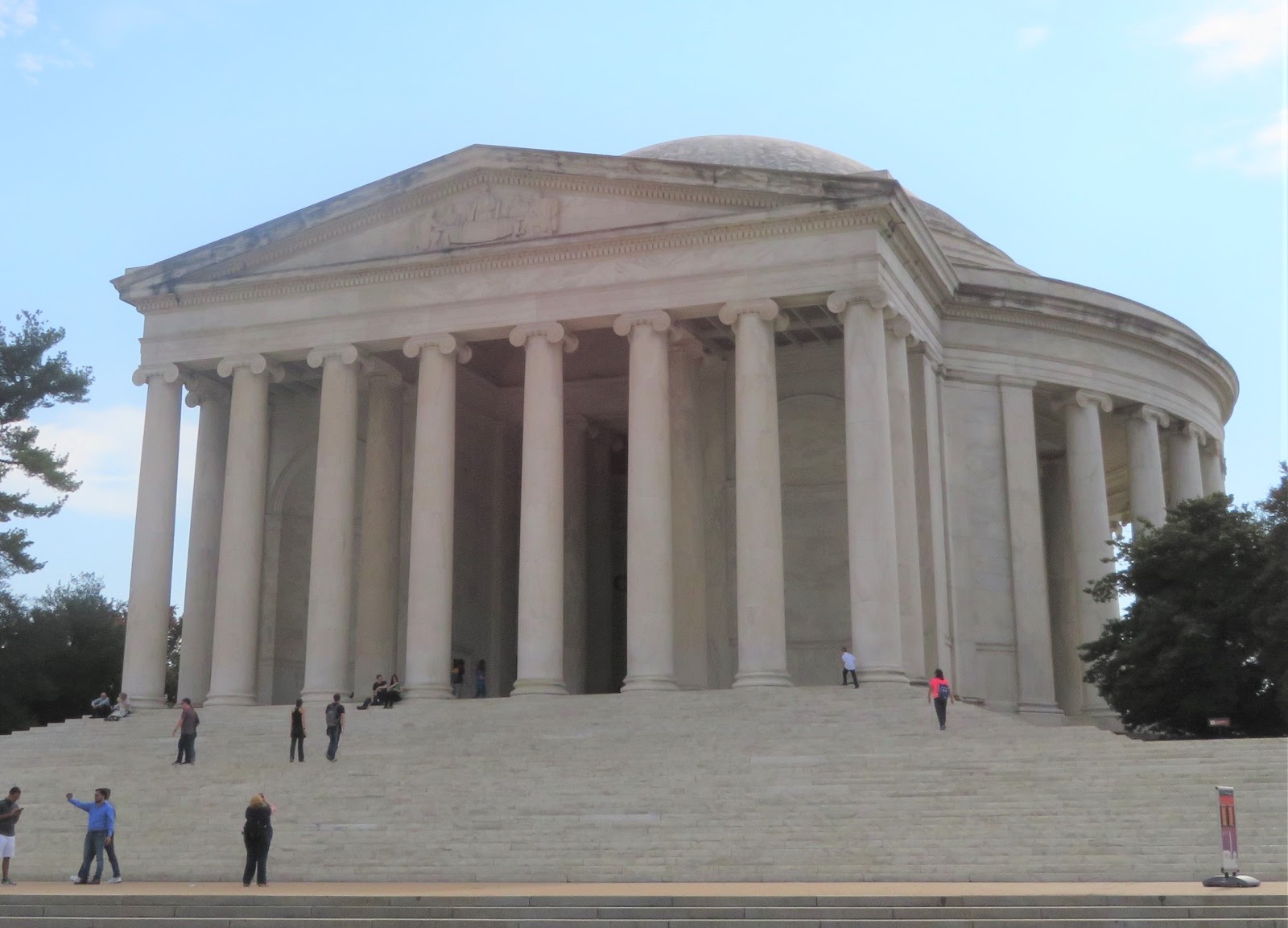
Across the Tidal Basin is another Neoclassical building with an abundance of stairs, the Thomas Jefferson Memorial.


Looking toward the Washington Monument from the Jefferson Memorial.

The bronze statue by sculptor Rudolph Evans is 19 feet tall.
Another president is remembered at the east end of the Mall, not far from the Capitol steps. Ulysses S. Grant sits on horseback, flanked by bronze sculptures of Union soldiers winning the Civil War.


Another great Neoclassical building is the National Archives, completed in 1937. It has the largest pediments in Washington DC, 118 feet wide. The north pediment, created by sculptor Adolph Alexander Weinman, is called "Destiny". In the center is a male figure representing Destiny, flanked by figures symbolizing history, peace, war, achievement, guardianship, and other concepts.

On the side of the building is inscribed, "This building holds in trust the records of our national life and symbolizes our faith in the permanency of our national institutions."
A statue outside the building advises us to "Study the Past."

Another warns that "Eternal vigilance is the price of liberty."

Inside we were very pleased to view our important national documents, the Declaration of Independence, Constitution, and Bill of Rights. Yes, the original documents, carefully preserved and sealed (and closely guarded), are available for everyone to see.

|

|

|
Photos courtesy of the National Archives

| Within walking distance of the Archives is the White House, which has been the official residence of every U.S. president since John Adams. Thanks to zoom lenses, these pictures do not reveal that it is no longer possible to approach the fence surrounding the White House grounds, and there is a very heavy presence of security guards, police, and Secret Service, as well as large crowds of tourists. We decided not to take the tour, but we walked all the way around and viewed the building from both the front and back. |


The National Christmas Tree was already in place, across the street from the White House.

On another day, we followed the "Logan Circle Heritage Trail", a self-guided tour in and around a residential district known for its 19th-century homes and historical sites.

John A. Logan is the centerpiece of Logan Circle.


In addition to all the sights described in this and the previous two posts, we visited several museums and galleries and saw many more monuments, buildings, and points of interest. We spent over two weeks in the D.C. area and took around 1,300 photos. Thanks to a great public transportation system, we were able to go just about everywhere we wanted without using our car.
 Black SUVs with heavily tinted windows were
everywhere around Capitol Hill. |

This bronze "Statue of Freedom" stands on top of the Capitol. |

Good to know. |

Architectural detail from a building near the Mall. |

A statue of Benjamin Franklin in front
of the old Post Office building. |

These are everywhere.
|
We left D.C. on November 18 and headed south.
We love seeing your comments on the blog. To leave a comment, please click here.


